


Market
July 28, 2026
Technical Discussions on Opportunities to Advance Industrial Thermal Processes.




Thermal insulation is an essential component in countless industrial assets, but in certain types of equipment, its presence creates an important challenge for teams responsible for maintenance and reliability: Corrosion Under Insulation, or CUI.
This is the case with pipelines, tanks, vessels, as well as other components with bends, connections, or complex geometries. In these applications, the most common configuration for thermal insulation consists of fibrous insulation blankets installed over the substrate and externally protected by metal cladding.
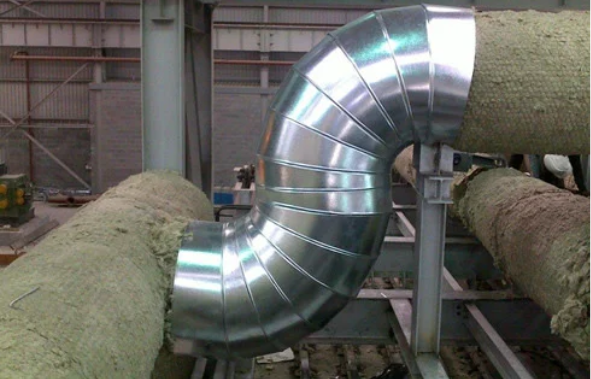
Due to the construction of this type of insulation, made up of metal cladding with multiple joints, the system presents significant challenges throughout operation:
The joints in the metal cladding are highly susceptible to seal failures over time, creating entry points for water and moisture into the insulation system;
When this moisture reaches the metal substrate and remains trapped beneath the insulation, it creates a highly favorable condition for the development of corrosion, which can also be accelerated by thermal cycling;
This corrosion remains hidden by the insulation system itself, since the metal cladding and insulation material prevent direct visual inspection of the substrate, making monitoring more difficult for the maintenance team;
The relevance of this problem is such that the AMPP (Association for Materials Protection and Performance), one of the leading international organizations dedicated to materials protection and corrosion control, classifies CUI as a serious threat to the integrity of industrial equipment.
According to the same organization, water ingress through the insulation is one of the main factors associated with the occurrence of CUI. Once this moisture reaches the metal substrate and remains trapped, the corrosion process begins and remains active indefinitely as long as conditions remain favorable to corrosion.
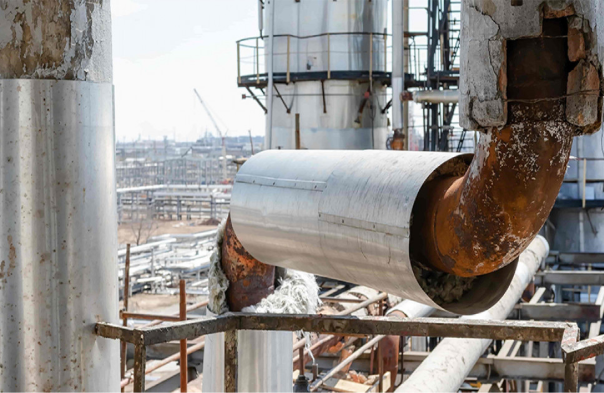
Corrosion of the substrate is only part of the problem. Water ingress into the insulation system produces different impacts simultaneously on integrity, maintenance, availability, and energy efficiency.
The main costs involved include:
Cost of loss of equipment integrity: metal corrosion can cause wall-thickness reduction and progressive deterioration of the component, requiring repairs or even replacement of the affected component;
Inspection and maintenance costs: in equipment insulated with blankets and metal cladding, inspection usually requires removal of the cladding and part of the insulation material. After inspection or repair, the system must still be rebuilt to restore it.
Costs from shutdowns and equipment unavailability: each inspection or maintenance activity on the insulation system can leave the industrial asset unavailable for hours or even days. The cost of this downtime can have a significant impact on operations.
Increased heat losses: metal corrosion itself is not what causes this increase. However, the same moisture ingress that creates conditions for CUI also accelerates degradation of thermal insulation blankets and compromises their performance.
The combination of all these factors generates significant costs that are often overlooked when specifying the insulation system to be used on an industrial asset.
For applications with surface temperatures up to 190 °C, an alternative to systems consisting of insulation blankets and metal cladding is to use an insulating coating applied directly to the industrial asset.
Mascoat Industrial DTI is an insulating coating developed to simultaneously reduce heat losses, protect workers against contact burns and protect the substrate against Corrosion Under Insulation.
Its performance is based on ceramic microspheres containing encapsulated air dispersed in a highly durable water-based acrylic matrix. While the microspheres significantly reduce heat loss through the coating, the acrylic matrix creates a continuous, bonded, seamless barrier.
This configuration eliminates the insulation blankets, joints, and external metal cladding found in conventional systems, reducing points susceptible to moisture ingress. In addition, it facilitates inspections and enables localized repairs through simple repainting, without the need to disassemble and reinstall different components of the insulation system.
In a case study published by Mascoat, DTI applications remained in service for periods exceeding 15 years, including equipment with approximately 18 years of operation and applications that reached 20 years in service.
Because it conforms to the shape of the surface, DTI can be easily applied not only to piping, but also to components with complex geometries. It is applied by spraying directly onto the asset substrate and can be carried out by the plant’s own painting crew, after brief training on the correct application of the product.
The coating is applied in 0.5 mm coats, observing the drying time specified by the manufacturer until the thickness required for the application is reached.
One of the case studies published by Mascoat illustrates this difference in configuration in practice.
At a sugar mill in the United States, two reheaters were used to compare a conventional insulation system with Mascoat Industrial DTI. One of the units used 63 mm of mineral wool, while the other received approximately 3 mm of DTI.
According to the study, no perceptible difference in thermal performance was identified between the two systems. The main difference was seen in installation and, especially, in maintenance requirements throughout operation.
Criterion | Conventional insulation | Mascoat Industrial DTI |
Applied thickness | 63 mm of mineral wool | ≈ 3 mm of DTI |
Thermal performance | No perceptible difference | |
Manutenção | Required regular maintenance | Required no maintenance after application |
Documented service life | Not specified | More than 12 years |
Installation | Extensive, due to fabrication and forming work | Quick, direct spray application |
Complex geometries | Greater difficulty fitting around the equipment’s various openings | Easily conforms to geometry and curves. |
Inspection openings | Sealing around the openings was problematic and required attention during installation and maintenance | Applied directly around the openings; only areas that should not receive the coating need to be masked |
Moisture ingress | Seal failures left the system vulnerable to moisture ingress | Coating applied directly to the surface, without the interfaces of the conventional system |
In the conventional system, the plant manager reported regular maintenance, mainly associated with the difficulties of fabricating and fitting the insulation around the reheaters’ inspection openings. These areas were also more vulnerable to moisture ingress and Corrosion Under Insulation.
By contrast, the reheater coated with DTI had accumulated more than 12 years of service without requiring maintenance on the insulation system when the study was documented.
Under the conditions of this application, therefore, just 3 mm of DTI provided thermal performance comparable to 63 mm of mineral wool, while:
Simplified installation
Minimized moisture ingress and the risk of CUI
Eliminated the need for the recurring maintenance recorded in the conventional system.
Want to understand how your operation can benefit from Mascoat Industrial DTI? Fill out our form and a consultant will contact you to understand the challenges faced by your industry

Technical Discussions on Opportunities to Advance Industrial Thermal Processes.

Used in a wide range of industrial applications, insulating boards offer important properties for the thermal insulation of equipment
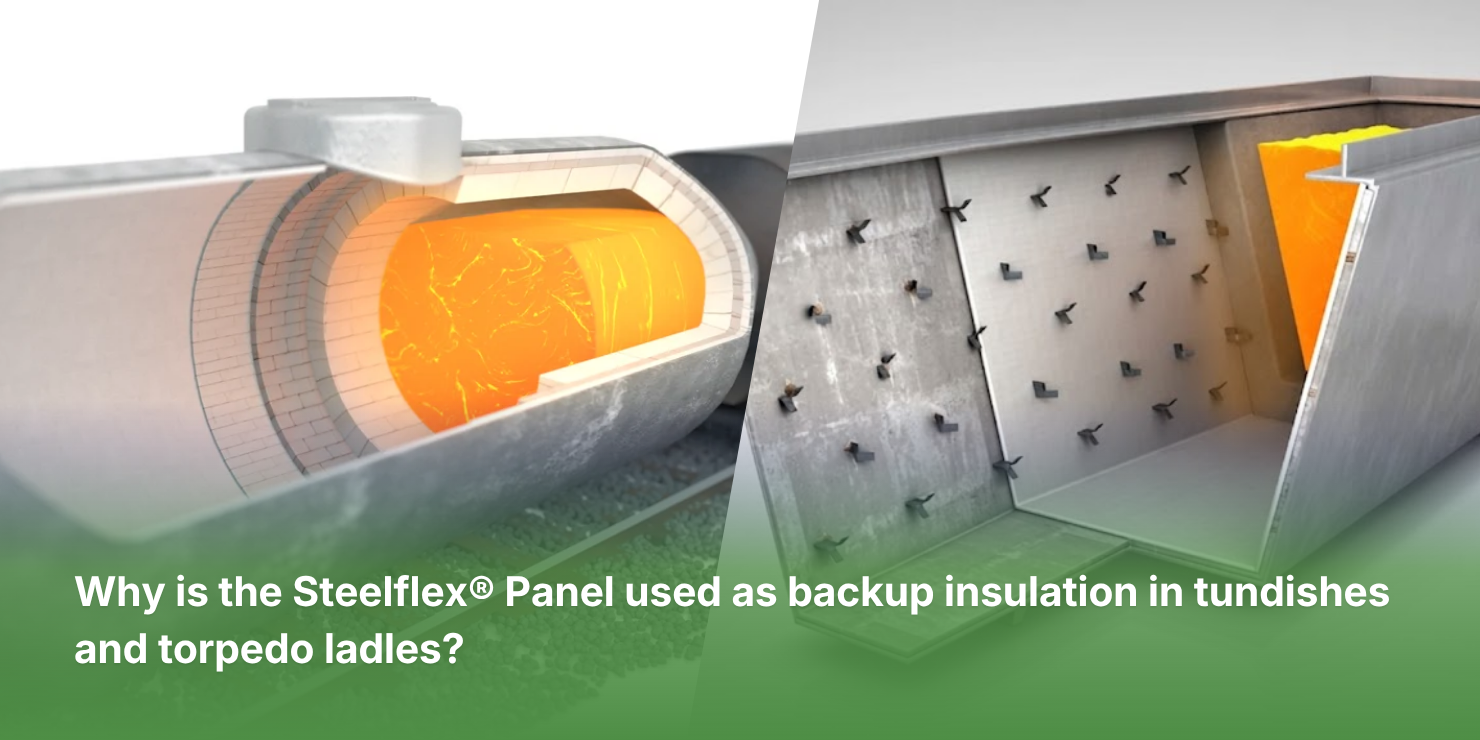
Low thermal conductivity, high mechanical strength, ease of installation and long service life are some of the factors that make Steelflex® an excellent choice for the steel industry.

 Carregando...


