


Mercado
October 16, 2026
As altas temperaturas industriais e a eficiência energética na ABM Week



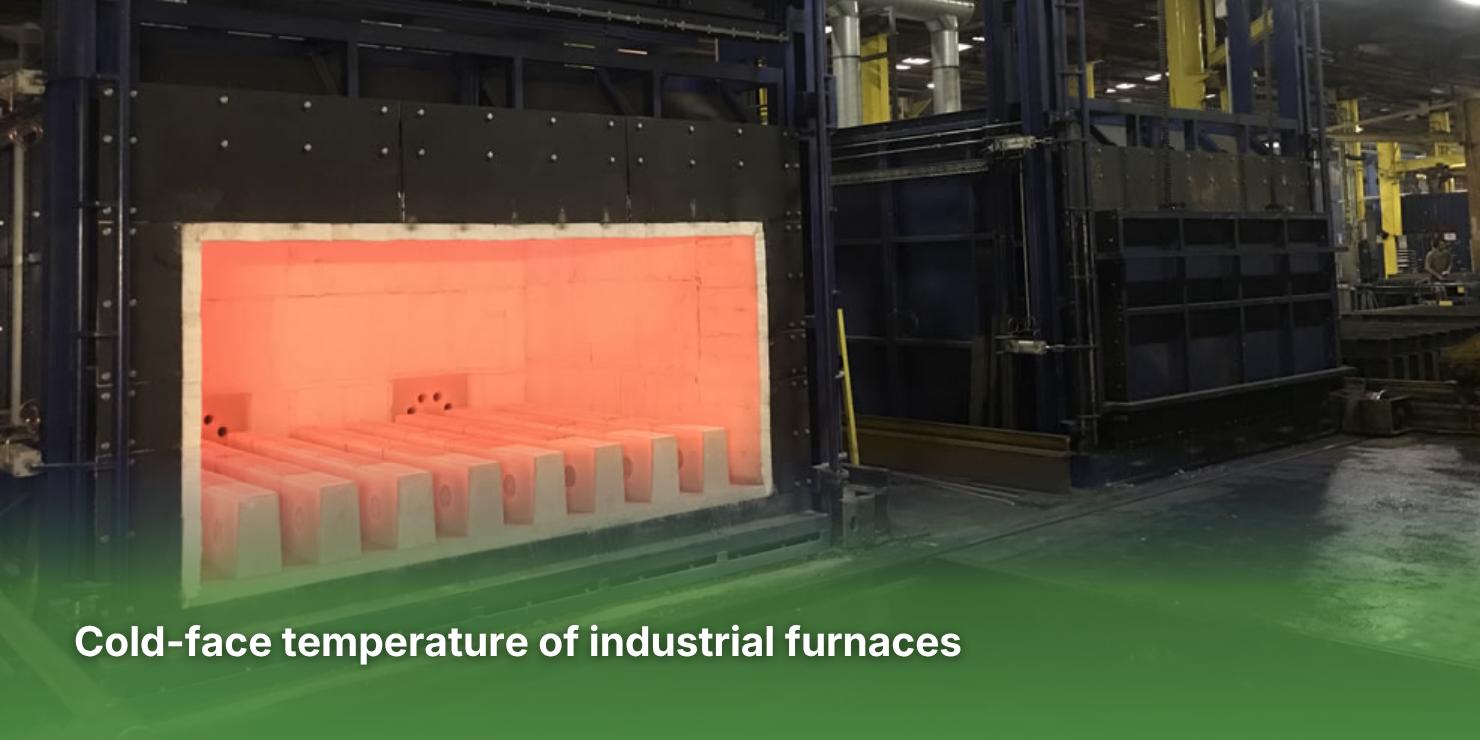
The cold-face temperature of an industrial furnace should be evaluated from at least two important perspectives:
The higher the cold-face temperature, the greater the heat loss, the greater the amount of energy required by the process to compensate for that loss and, consequently, the higher the energy cost;
The higher the cold-face temperature, the greater the risk of burns to equipment operators and maintenance personnel.
The benefits of a low cold-face temperature are therefore clear. This condition is achieved through the installation of an appropriate thermal insulation system. However, when specifying thermal insulation for industrial furnaces, there comes a point at which the cost of the insulation increases disproportionately in relation to the benefit obtained.
For example, a 25% increase in insulation thickness, and consequently in cost, may result in a reduction of only 2 °C in the estimated cold-face temperature. In practice, the optimum point in this cost-benefit relationship is therefore close to a cold-face temperature of 60 °C* for furnaces with hot-face or process temperatures between 400 and 1,200 °C.
When assessing EN ISO 13732-1, which addresses the ergonomics of thermal environments and methods for assessing human responses to contact with surfaces, Part 1: Hot surfaces, it is reasonable to assume that, in industrial furnaces:
The material of the furnace’s external surface is normally metallic;
Contact is unintentional and, in most cases, there is sufficient space around the equipment to allow the body part in contact with the hot surface to be withdrawn quickly, corresponding to an exposure time of 0.5 seconds;
The surface is normally painted, with a coating thickness of 60 micrometres;
The person coming into contact with the hot surface is normally an adult, with fast reflexes.
Using the tables and graphs provided in the standard and the assumptions listed above, it can be concluded that the optimum cost-benefit point in terms of heat loss, corresponding to 60 °C¹ in industrial furnaces, is also suitable in relation to the indicated burn threshold because:
Temperatures up to 73 °C do not cause burns;
Temperatures between 73 and 79 °C are within the threshold range and may cause burns;
Temperatures above 79 °C cause burns.
However, national signage, shown in Image 1, and international signage, shown in Image 2, are recommended to warn equipment users of the presence of a hot surface.
¹ Calculated in accordance with ASTM C680, considering an ambient temperature of 27 °C, an air velocity of 0 km/h and a surface emissivity of 0.9.

As altas temperaturas industriais e a eficiência energética na ABM Week

A Perfil Térmico participou da 11ª Semana de Inovação com Fornecedores da Novelis, uma das principais referências mundiais em laminação e reciclagem de alumínio, e o encontro confirmou algo que acompanhamos de perto no dia a dia da indústria: as soluções mais consistentes surgem quando cliente e fornecedor trabalham juntos com a mesma visão.
Confira as etapas para calcular a economia do isolamento térmico do seu forno, com exemplo real de retorno em menos de 09 meses


